

Camino de Santiago vs. GR11: why one is the gateway and the other is what lies behind
Pyrenees and mountains 📩
Here 🔥It's not that one is better. It's that they are different questions.
I've seen it many times. Someone finishes the Camino Francés, arrives in Santiago with heavy legs and a huge smile, and a week later they're already looking at maps. Something has been awakened. A sort of itch that doesn't go away with a shower and a decent bed.
And almost always, the next search leads to the same place: the GR11. The Trans-Pyrenean Trail.
That makes sense. The French Way of St James is accessible, it's signposted like an airport, and it has brutal infrastructure. Hostels every few kilometres, bars, pilgrims everywhere. In many ways, it's the best entry point to this whole thing of walking for days on end. But if you've been through it, you know that at some point you start looking sideways and wondering: what if I go a bit further?
The GR11 answers that question in one fell swoop.



First, the numbers.
The Camino Francés is 800 kilometres from Saint-Jean-Pied-de-Port to Santiago. The GR11 is between 840 and 850 kilometres from Cabo Higuer, in the Basque Country, to Cap de Creus., on the Catalan Costa Brava. Similar distances on paper. That's where the similarity ends.
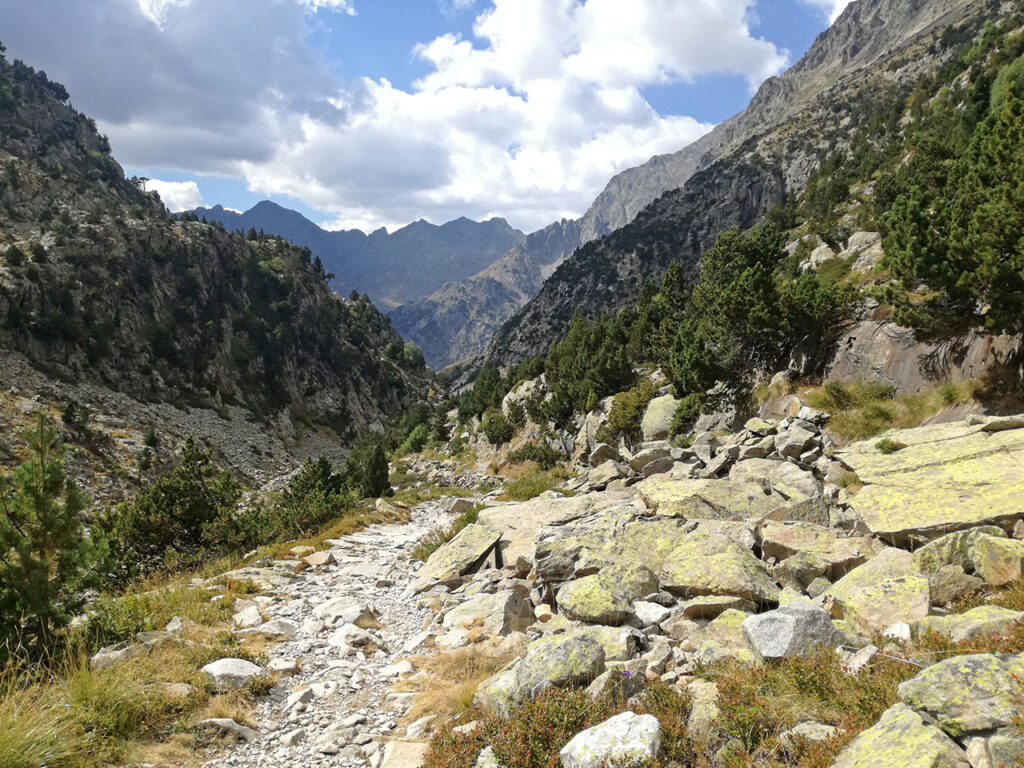
The Camino accumulates about 10,000 metres of total positive elevation gain. The GR11, depending on the variants, is around 39,000 metres.. Nearly four times as much. The route crosses the Pyrenees transversely, from valley to valley, meaning that each day includes a significant ascent and descent: some days accumulate 1,600 metres of climbing with its equivalent of descending. On stages such as Pineta, in the heart of the Aragonese Pyrenees, there are 1,000-metre walls to climb or descend in very few kilometres. That doesn't exist on the Camino Francés or any of the other routes of the Camino de Santiago.
The average duration for the complete GR11 is between 40 and 45 days for most hikers. Some complete it in 25-30 days with a lighter and faster approach. And then there's Kilian Jornet, who ran it in 2010 over 8 stages at more than 100 kilometres daily. Or Fernanda Maciel, who did it in 2025 in 12 days, but that's in a different league.

The gradient trap.
The Camino Francés has its tough spots, the Alto del Perdón, O Cebreiro. But these are exceptions on a route that's mostly flat or with gentle inclines. The GR11 has no exceptions: uneven terrain is the norm.
This has concrete physical implications. The descent is where people break, not the ascent. The quadriceps work eccentrically during the descent, and if they haven't been specifically prepared for it, the knees quickly feel the effects. Before tackling the GR11, it makes sense to incorporate eccentric quadriceps work, strengthen the ankles for technical and uneven terrain, and go on outings with real elevation changes while carrying the weight of the backpack. Simply accumulating flat kilometres is not enough.
The terrain also changes the equation. The Camino Francés mostly follows technically simple paths and some tracks. The GR11, especially in the central section of the Aragonese and Catalan Pyrenees, the scree sections, the crossings of residual snow patches early in the season, and the passes above 2,500 metres are unforgiving.

Logistics, that big differentiator.
The French Way has an infrastructure designed for you not to have to think too much. Hostels every few kilometres, bars, shops, signage so clear that it's practically impossible to get lost. You can leave home on the first day without having looked at a map and arrive in Santiago without any problems. That accessibility is one of its great virtues.
The GR11 is something else entirely. The route is well-signposted with the white and red GR markings, but there are sections where prior planning is crucial. In the central part, the wildest section of the trek, there are stages that end in manned refuges, but also others that finish in unattended refuges – simple, unserviced huts – or directly at spots where you'll need to camp. The reality is that these instances are few, but they are where you need to work on your planning, as you'll need to align the end points of your stages very carefully. If you want more freedom on the GR11, that means carrying a tent, sleeping bag, and enough food until you reach the next village. The rucksack gets heavier, your independence increases, and the management of water and weather become actual, not theoretical, decisions.
The eastern and western sections of the route, the Basque Country, Navarre and the easternmost part of Catalonia, are gentler and have more infrastructure. The heart of the Pyrenees, Aragon and part of Catalonia, is where the route becomes truly wild.
To get your bearings before leaving, the GR11 Pyrenean Traverse Guide It remains the most complete reference, with the stages and variations explained in detail. And the Pyrenean Crossing Club it's the community where you get help and chat so you don't have any problems with the preparation. And the GPX of the route, which can be loaded onto any navigation app, is practically essential for technical sections.
Must it be done in one go?
No. This is perhaps the most liberating question for someone approaching the GR11 for the first time.
The Camino de Santiago is almost always walked in its entirety, in one go, as its narrative logic – and its infrastructure – are designed for that, although many people also plan it as a multi-year project. The GR11, even more so, is perfectly suited to being walked in sections, at different times of the year or over different years, linking parts together depending on the available time. Some people take three or four years to complete it, walking for a week or ten days each summer, choosing the sections that most interest them or that suit their skill level at the time.
The ideal season is July and August, when the high mountain passes are clear of snow. June and September are possible, but require more attention to the weather and the condition of the higher passes.

What isn't measured in kilometres.
This is where the two paths are more alike than they first appear.
The Camino de Santiago carries an enormous symbolic weight, religious for some, philosophical or simply existential for others. But the transformation it produces – the one that turns 30 days of walking into a turning point – doesn't come from the cathedral or the botafumeiro. It comes from the hours. From walking for many hours alone or accompanied, without the usual distractions, with the landscape as the only horizon and your own thoughts as your only permanent companion.
The GR11 has that too, amplified by the isolation and the physical demands. People who finish it talk about it as a life project, not a hiking trail. It's not hyperbole. Fifty days crossing the Pyrenees on foot, sleeping in small refuges, perhaps wild camping (where we can), watching the sunrise from a pass at 2,700 metres, dealing with unforeseen events without a safety net… That leaves its mark.

In the background, Lecherines and Aspe.
The correct question is not which is better.
The correct question is which one is yours right now.
The Camino de Santiago is an extraordinary route. It's the best way to get started with walking for days on end, carrying what you need on your back, and discovering how the rhythm of your legs can calm your mind in a way few things can. If you haven't done it, do it.
But if you've already done it and feel like you're left wanting more, more technical terrain, real solitude, your own planning, and mountain with a capital M, then the GR11 isn't an option. It's the answer.
Fastpacking is not about going faster. It's about going lighter.
If you come from classic trekking, this is the next step: learning to move with less weight,
more fluid and enjoying every kilometre more.
Join the Outsiders Newsletter and start discovering what lightness feels like.


