

47 days, three crossings and only one Pyrenees: a chronicle of the Pyrenean Triple Crown

Pyrenees and mountains 📩
Here 🔥Burriana, 14 November 2025
When I discovered that the so-called Triple Crown of the Pyrenees existed, I found a way to close a circle that I knew I had been waiting for many years; I will tell you...
I am Ramón Peris, a lover of many things, including the mountains.
One day 15 years ago, a patient, and above all a friend, told me about his experiences when he had spent years doing sections of the GR11 until he managed to complete it. Every time he came to me, I asked him for details of the places, the experiences and the adventures he had had. Day by day, I grew more and more anxious to say “one day I will do the Trans-Pyrenees”.
At that time, around the age of 40, I had already taken up sport again as a daily activity and, in particular, running on asphalt and especially in the mountains, while continuing to go mountaineering and skiing. I had a bit more free time again with my children a bit older and freed from some of the jobs that used to take up a lot of my time.
Also at that time, for personal and professional reasons, I started to know and practice minimalism and after a first challenge, crossing Spain from east to west with 5fingers, I thought it was time to take the leap to the mountain with minimalism.
So, in 2016 my team and I decided to try to complete the GR11 in the shortest possible time and in semi-self-sufficiency, i.e. carrying everything we needed in our backpacks and eating and sleeping in refuges, hostels or villages.
With only one pair of Merrell shoes, we were able to complete this challenge in 14 days and 9 hours; a total of 811km with an elevation gain of 40644+/-.

That experience was spectacular, shared with a lot of friends and family who accompanied us all along the route, or on specific stretches, with endless 12-18 hour days.
While doing that sporting challenge I discovered that there were other GRs through which I could do the Trans-Pyrenees Crossing and the idea remained in my mind that maybe one day I would do this adventure again.
The years went by as new sporting challenges and now, also, solidarity challenges in solitary or in pairs, were posed.
Two years ago, reading Travesía Pirenaica magazine, I heard for the first time about the concept of the Pyrenean Triple Crown, its origin and meaning. It stuck with me and I knew that sooner or later, one way or another, I was going to do it.
A year ago I informed my team of my intention to do the ARP first and, depending on how we finished, to do the GR10 in the same summer or leave it for the following summer.
We got down to work and on 16 July, from Hendaye, we started this great adventure that culminated on 30 August in Banyuls, after completing the ARP and the GR10 with a 12-day break; well, a break from running but not from work.
In the end this summer was 33 days, 1569km and 103000+/-.
This, together with 2016, makes for some frightening figures... 47 days 9 hours, 2380 km and 143644 +/-
I think I still need time to process everything a bit, but first I could comment on common and different aspects of each route, from my experience; for that we are going to analyse different aspects, come on....



Hardness and difficulty
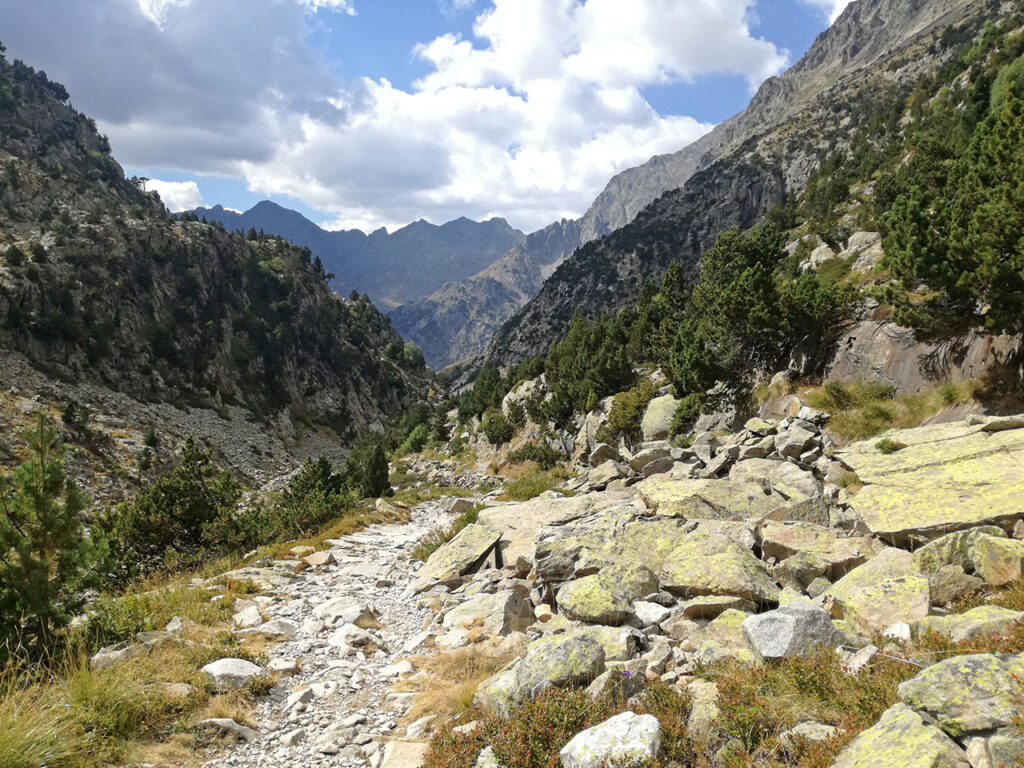
Definitely, the ARP is the hardest of the 3; you are always moving through high mountain areas, very exposed, more areas, where the most extreme hours of the day, both cold and heat, are much more evident. The terrain is also more rocky and not as wooded as the GR10 and GR11; this means that it takes longer to gain kilometres and more elevation gain than when the terrain is more hilly and more progressive. Another element of difficulty of the ARP is the steep slopes on the ascents and descents with long stretches of steep gradients in one direction or the other.
With regard to the weather, the GR10 has been very punishing due to the time of year we have done it and this has meant that it has been harder than if we had done it in July. The GR10 has to be done in July or the first fortnight of August, as from then on it starts raining every day, intensely and constantly, which makes it very difficult to do such long stages. The fact that it is a north-facing route explains this.
On the other hand, the GR11, being south-facing, is very hot at the same time of year.
Lastly, I would like to comment on the hardness that, logically, it also depends on how long the stages are, the number of days you want to do each route and how much weight you carry in your backpack.
Either way, either you are physically fit and can do long stages and complete the challenge in a short time, or you have to think about doing stretches or dedicate a month to each trail to be guaranteed success.

Signage
This is very easy to understand... both the GR10 and the GR11 can be done without GPS as they are very well marked and you also have the option of taking alternatives that are also considered GR and make the route more or less demanding. Those responsible for the maintenance of these GR (white and red markings) deserve recognition for their dedication, for the details of the information and for the care they take of the markings.
The problem with the ARP is that it is not a specific route but a route that coincides in sections with the GR10 or GR11, but that most of its route runs along PR (yellow and red in France and yellow and white in Spain) or other paths that are not exclusive to this route. They are sections marked with a yellow line that in France is used for this route or for many others, so if you do not use a GPS it is very easy to make a mistake and take a path that takes you away from the correct route and this in the mountains can make the difference between success or failure, between everything going well or getting into a problem that is difficult to manage.
Logistics
GR10 and GR11 have nothing to do with the ARP.
Of the 3, the GR11 has the most resources and facilities, followed by the GR10.
On the GR11 you pass through many villages and there is a different culture of food, timetables and facilities than in France, where the timetables are stricter and the variety, I think, is less, although in general I have to say that all the people in the refuges, hostels and albergues have a special sensitivity for the people who go on these demanding adventures and, in general, you feel very well looked after and cared for.
It's a bit more complicated in the ARP because you spend many hours alone, there are far fewer villages and the distances between places to rest or eat are much greater. This means that you have to have more foresight, carry more food and not rely on eating from the places you pass through because, as I said, you can spend many hours without being able to stop somewhere specific.

Requirement
I think the ARP is more demanding, it requires you to be physically much better, more prepared, it's a very mountainous route, much less of a runner than the GR10 and GR11. The ARP puts you to the test, it takes you much more to the extreme than its other two sisters and you have to be more of a mountaineer than a mountain runner.
Mentally, the ARP is also more demanding for several reasons; on the one hand, you spend many hours with no one to meet; being a less frequented crossing, you have to make loneliness your companion and not everyone copes well with this. On the other hand, you have to be aware that the temperature changes towards the extremes will make you doubt your chances of success, and this is something that happens every day, which requires a level of resilience and sacrifice.
In my case, this was compounded by the fact that, as I wanted to do each trip in the shortest time possible, I had to do a lot of kilometres, a lot of slope or both, every day, so, as I am not a top or a crack in this mountain, I had to make up for it with more hours every day and this translated into few hours of sleep, more hours exposed to the mountain and an inability to recover well from one day to the next.
Beauty
Frankly, it's impossible for me to choose just one of the three crossings, just as it's equally difficult to choose a particular section of each of them.
You start in the Atlantic Pyrenees, with all the Basque-French area with its spectacular green and its seas of ferns and endless meadows, to continue through the Irati forest and all the Navarrese Pyrenees or its equivalent in France, in the area of New Aquitaine, with its valleys of Bèarn, Ossau, Aspe and Barétous. Ossau, Aspe and Barétous.

And what about the most demanding and toughest part of the Pyrenees, the Central Pyrenees, the area of Huesca and the Hautes Pyrénées and Haute Garonne; this part puts you to the test, it is wilder, more exposed and aerial, as tough as it is beautiful.
Then you reach the Western Pyrenees, the Catalan Pyrenees and Occitania with a more Mediterranean landscape with a lot of Scots pine in the lower areas and beech and fir forest in the higher, wetter areas.
In the middle of this part of the Eastern Pyrenees lies Andorra, all of it lush with long wooded slopes, which protect you from the weather and at the same time punish you with steep slopes.
Each crossing has a thousand charms and within each one of them, each stage, each climb and each descent, gives you a gift that will not leave you indifferent.
The whole of the Pyrenees is a universe of experiences, of sensations in the form of landscapes, noises, silences, animals and vegetation that are in no way inferior to the great mountain ranges of other continents.
Preparing for an adventure like this is quite difficult, proof of this is that no two days are the same, every climb or descent, every valley and every path is different from the previous one, different from the day before and not useful for the next day either; So, you simply have to worry about being physically very well and, above all, prepare yourself mentally; be aware that every day there will be some kind of adversity in the form of changing weather, tiredness, pain, lack of water or food, lack of energy, lack of sleep or too many climbs or descents, etc.
The issue is not what is going to happen, which I insist, every day it is very easy for something to happen, but how you are going to manage it, what you are going to do in the face of adversity, how you are going to value each small success, how you are going to hold on to the good things of each day or how you are going to transcend the fact that every difficulty should make you stronger and above all that every difficulty will always end up passing.
When you are able to do this mental work, when you put yourself in situations that are complicated, difficult to manage and you come out ahead, you are putting up the bricks of the wall that you have to build to not let your emotions or your tiredness make you hesitate, back down or give up.
And at the same time, as important as this is the fact of knowing how to accept, to understand that we often have to accept that nature has its laws, its times and that we are playing on its terrain and that, therefore, we have to accept its rules and its whims or its rhythms. And so, when she makes you realise that you have to stop, or that you have to spend more days than planned or that it is time to rest, you have to be humble, know that you are not more than she is and know how to take a step back.
All this is something that is acquired by trial and error, in every training session you do, every weekend you go on a route and so, with patience and humility, the day comes when you feel ready to take on a challenge like this.
Honestly, in these 3 challenges I have gone through extreme situations, of cold or heat, of difficulty and even danger, but it is in those moments when you have to show calm, fortitude, patience, trust and faith. These are the tools that allow you to move forward and continue to enjoy every sunrise or sunset, every path or every river, every tree or every animal, every valley or every peak.
In my case, I had an extra motivation, which was to try to raise funds for the NGO Youcanyolé, which organises medical expeditions to Kenya and Ghana. We are working with them to build hospitals in the most disadvantaged areas and for very vulnerable populations.
Having raised more or less money was important but, above all, it was more important to give visibility to these realities and to try to make people loyal to these projects.
Thinking about these people with so many shortages and lacking everything made me minimise my pain, my tiredness, lack of sleep, hunger or fatigue; and when you know such harsh and extremely complicated realities of life, one can only feel truly privileged to have been born in Spain and to be lucky enough to be able to fulfil these dreams or others that are unthinkable for thousands and thousands of people.
For me, these three treks have been a life lesson, I have matured a lot in aspects such as resilience, patience, acceptance, gratitude and self-management, as well as teamwork. In fact, if I review how I managed everything in the GR11, 9 years ago, and how I have done it now, I see a great maturity, less impulsiveness, more sense but the same or more illusion.
In the end I would advise you, if you are thinking of doing one of these routes, to take it as a way of learning, of self-knowledge, of personal growth and integration in nature and of relationship with yourselves, with life and with God if, like me, you are believers.
When you finish, you will be a different person, of that you can be sure.
Now it's my turn to continue maturing everything I've experienced, savouring it from the perspective that time and distance give you. I close this stage of extreme challenges in the Pyrenees, with great satisfaction and gratitude for having been able to complete it and overcome all the adversities, for having enjoyed myself as I believe I will never do again and for the luck of having felt so accompanied and loved.
I know I will keep coming back to the Pyrenees every year, because the Pyrenees mark you forever and leave a tattoo of happiness that nothing and no one can erase.
Fastpacking is not about going faster. It's about going lighter.
If you come from classic trekking, this is the next step: learning to move with less weight,
more fluid and enjoying every kilometre more.
Join the Outsiders Newsletter and start discovering what lightness feels like.


