

The journey continues when you return home: how to relive a trekking adventure

Pyrenees and mountains 📩
Here 🔥The journey ends when you come down from the mountain, yes, but the experience does not.
Anyone who has done a route of several days, a crossing of the Pyrenees, a week linking valleys, knows that strange feeling on returning home. The body adapts quickly, hot shower, soft bed, normal schedule. The head, not so much.
For days, sometimes weeks, single scenes reappear. A wind-swept hill. A late-night conversation in a shelter. A decision taken with fatigue that, seen from home, takes on a different meaning. To return is not to close. It is to change phase.
The «after» that almost no one plans for
We plan beforehand with obsession: maps, gradients, stages, water, weather. During the route, we are present, attentive, focused. But the after is often left in no man's land, as if the experience ends when the backpack is put away.
However, it is here that many real lessons are learned. When fatigue no longer rules, when the epic fades and the essential remains, we begin to understand what really happened during the journey.
I've seen this dozens of times. You come back from the GR11, from any of the Trans-Pyrenees from end to end, or one of the circular treks in the Pyrenees, and during the first week you don't stop talking about the route. But two weeks later another, quieter, more personal conversation begins. The one you have with yourself while you have a coffee looking out of the window, or when your head returns without permission to that moment when you decided to keep going even though everything in you was asking to stop.
Back to the map
Opening the track a few days after the trip is an almost therapeutic exercise. You are no longer in the middle of the effort, your backpack is no longer weighing you down and you are no longer pressed by the timetable. And, from that distance, the map begins to tell a different story.
Suddenly you understand why that descent destroyed you more than expected, or why that col was a mental turning point. The elevation profile that was once just strategy is now pure narrative. Every peak on the graph has a name, has context, has emotional weight.
Review photos, your trekking adventure in pictures
During a crossing we usually take a lot of photos. When we come back, most of them are left over. The selection process is revealing because it forces you to decide what was really important.
Often it is not the most spectacular images that survive, but the most honest ones. Or the ones that tell a story. A poorly pitched tent at dusk. A hot plate in a crowded shelter. A sunrise without great views, but in absolute silence. Those that recall a conversation that went so far inland.
Years ago I made a crossing of the Pyrenees mountain range. I had a decent camera, I looked for angles, I waited for the right light. But the photo I have looked at most often is one I took almost without thinking, on the pass of Brazato, once I had crossed it, and descending to the other valley, with the Vignemale, its south wall in the background. It has unwittingly become a narrative of the very spirit of Travesía Pirenaica. Every time I see it, I go back to that exact moment when I, a little behind in the group, clicked the shutter.
Calmly reviewing photos transforms loose memories into a coherent narrative. It's not about showing where you were. It's about understanding what you take away from it.
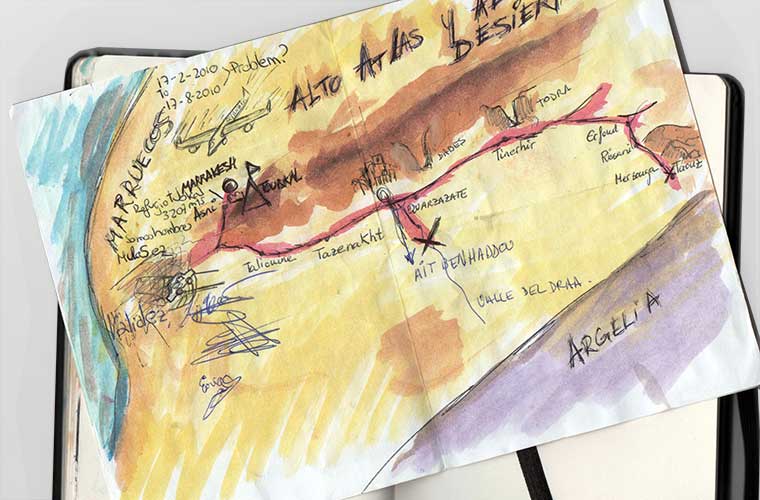
Writing to put the lived experience in order
Putting words to an adventure is one of the most powerful - and least used - exercises in the trekking world. You don't need to write well or publish anything. It is enough to write sincerely.
When you write down what cost you more than you expected, what you would repeat the same way or what you would not do again, you learn things you were not aware of on the route. Trekking reduces the mental noise; writing afterwards tidies up the experience.
Colin Fletcher, one of the pioneers of long-distance trekking in the United States, always carried a small notebook. Not to write during the trek, but to write it all down at the end of each day, in the tent, before going to sleep. He wrote without a filter: pains, decisions, conversations with himself, changes of plan. Years later, those notes became books that defined a generation of walkers. But even if he had never published them, the exercise would have served him well. To write is to turn experiences into one's own knowledge.
Video as moving memory
The video adds a different layer to the memory of the journey. It doesn't just show images, it brings back the rhythm, the atmosphere, the sounds that accompanied each stage. The wind on a hill, the crunch of the gravel under the boots, the long silence of a morning walking alone.
More and more mountaineers are editing short videos on their return, not with the intention of sharing them, but as a personal archive. Short clips that don't tell everything, but evoke a lot. A way of re-entering the scene without the need for words.
At this point, some people seek to accompany these images with a sound atmosphere that fits in with what they have experienced. Today there are very simple digital tools that allow this to be done without technical knowledge. For example, creative resources such as a AI music generator, which some travellers use to create music associated with their trekking memories. It is neither essential nor universal, but it shows the extent to which the journey can continue to be reinterpreted once back home.
The tool is secondary. What is important is the intention: what you want to keep from that experience.
When adventure becomes a mirror
As the days go by, the route ceases to be a succession of stages and becomes something more profound. You begin to ask yourself why you needed that journey, what exactly it gave you and what place it now occupies in your daily life.
I know a mountaineer who, after every long route, asks herself three questions in writing: At what point did I feel I was exactly where I was supposed to be? At what point did I want to be somewhere else? What did I learn about my decision-making under pressure? He doesn't answer them all at once. He leaves them open for weeks, and comes back to them when something reminds him.
That is reinterpreting. It is not nostalgia. It is using the mountain as a tool for self-knowledge. Because if you pay attention, each traverse shows you something about yourself that you didn't know: your relationship with fear, with tiredness, with uncertainty. The way you react when things go wrong. The speed at which you regain your composure after a scare.
All this is on the route. But you only see it when you look back calmly, without haste, without your rucksack on.
The next journey starts at the previous one
Here is the paradox: reliving an adventure does not anchor you to the past. It prepares you for the future.
Each route you process carefully becomes a reference for the next one. You learn to better calibrate your pace, to identify warning signs before it's too late, to distinguish between passing fatigue and real exhaustion. You start to know your real range, not the one you imagine from home, but the one you have verified on the ground.
The great mountaineers are not those with the most strength or the most technique. They are those who have refined their judgement by reviewing previous decisions, by learning from their own mistakes and successes. They don't improvise from scratch every time. They build on what has gone before.
So reliving an adventure is not romanticism or nostalgia. It is maintenance. It's a serious mountaineer's way of making sure that every trip counts twice: once while you're living it, and again when you're processing it.
Returning home is not the end of an adventure, but a change of format. The bush teaches you as you walk, but also when you look back calmly.
 Spanish
  English
  French