

GR11: The rugged backbone of the Pyrenees

Pyrenees and mountains 📩
Here 🔥Editorial: From Travesía Pirenaica, we are excited to share this adventure signed by Geert van Nispen, one of the European references in self-sufficiency and long distance in the mountains. His challenge: to join GR10, GR11 and HRP in a single trip. Here is his account, in first person.
This article is an authorised translation of the original published by Geert van Nispen on his website: GR11 trail: The raw backbone of the Pyrenees
Three routes. One mountain range. One shared story.
The Pyrenean Triple Crown adventure, for which it's now time to rest, retrain, and continue preparing, has been postponed. Sometimes an adventure doesn't call for speed, but for patience. It's for precisely this reason that I'm returning to the three legendary routes that form the backbone of this mountain range: the GR10, the GR11, and the High Pyrenean Route. I return to two of them through memories; to the third, above all, through desire.
📋 The "Pyrenean Triple Crown is a concept inspired by the renowned "Triple Crown"The Triple Crown is a challenge to complete three of the most iconic long-distance treks in the United States. The American Triple Crown is a challenge that involves completing three of the country's most iconic long-distance routes: the Pacific Crest Trail (PCT), the Appalachian Trail (TA) and the Continental Divide Trail (CDT). These trails total more than 12,000 kilometres through some of the most breathtaking scenery in North America. HERE ALL THE INFORMATION ABOUT THE ROUTE.
This is the story of the second route. The GR11. The rugged backbone of the Pyrenees.
After the green softness of the GR10, my gaze inevitably drifts towards the southern slope of the Pyrenees. Towards the GR11. Not to discover it, because that stage was left behind a long time ago. But to return. Because this route barely changes, but I do.
While the GR10 gives you space to settle in, the GR11 demands you hold your ground. Everything here is drier, more open, and quieter. There's less water. Less shelter. And fewer concessions. The mountains reveal themselves unfiltered. This isn't an invitation, but a confrontation. It's not a gateway, but a backbone.

A return without softening reality
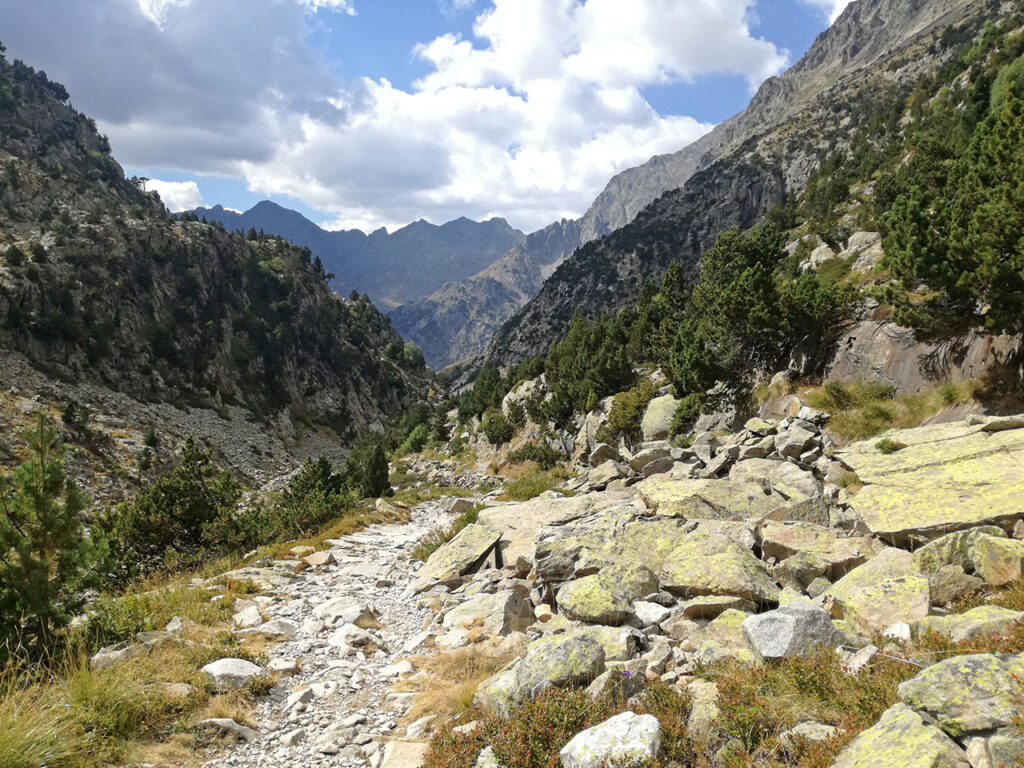
From the first steps on the GR11, it's clear I'm on familiar ground, but never comfortable. The landscape opens up much sooner than on the northern slope. The forests give way to stony slopes and dry grass. The paths are rougher and the lines straighter. Shade is scarce and the sun makes its presence felt even when the day has barely begun.
Precisely because I know what awaits me, I proceed with caution. My pace is controlled. My decisions are functional. On this route, attention isn't an advantage: it's a necessity. Those who let their guard down rarely notice it immediately. The bill usually arrives hours later, when fatigue sets in and error margins disappear.


A vacuum that hides nothing
Soon the void takes over the landscape. Villages appear increasingly separate and, at times, disappear completely from the horizon. For hours I walk through an environment where there is no distraction. No sound beyond the wind, my breathing, and the scuff of my trainers against the rock. No colour to soften the harshness of the terrain. No shape to divert attention from what is truly important.
And yet, this emptiness feels familiar. It is part of the essence of the GR11. At the same time, it remains relentless. Everything superfluous disappears. Thoughts become simplified. Doubts become more visible. The only thing that remains is movement. Step by step. Hour after hour.
Precisely because of that, concentration arises. Not through calmness, but through repetition. Days acquire structure, not thanks to planning, but out of sheer necessity.


Sun, rock and repetition
The southern slopes of the Pyrenees are tough. The sun isn’t just part of the scenery; it’s a factor that must be constantly taken into account. Shade rarely appears when you need it. Water sources are sporadic and never guaranteed. The terrain consists of loose stones, rugged paths and slopes that offer no room for error. That is why the GR11 is not about heroic moments, but about discipline. It’s about water management. It’s about sticking to a schedule. And it’s about recognising your limits before pushing beyond them. The ascents and descents are direct. Less gentle. Less forgiving. Every ascent demands effort. Every descent requires concentration.
The fastpacking it comes up naturally here. Sometimes running where possible to save time and energy. Sometimes walking where necessary to maintain control. Not out of ambition, but out of efficiency. The trail running and hiking are continuously blended, guided by the terrain, heat, and physical endurance.
Functional meetings
When a village finally comes into view, it doesn’t feel like a romantic moment, but rather a place to rest. A pub. A small shop. Sometimes just a fountain and a bench in the sun. Just enough to regain your strength and carry on.
The GR11 doesn't invite lingering. Encounters are brief and to the point. A greeting. A nod of the head. Perhaps a warning about the weather or the next pass. Little is said, but what is said is usually important. Then the silence returns.
And that austerity fits perfectly with the route. Everything has a function. Everything is in service of progress.
Self-sufficiency as a basic condition
On the GR11, self-sufficiency is not a lifestyle choice, but an indispensable requirement. Thinking ahead is essential. Water must be planned for. Food adjusted. Rest periods chosen carefully. Not everything can be sorted out on the go.
And yet, there is a sense of calm there too. Because I know what I’m carrying. Because I know what I’m capable of. The fastpacking enhances that feeling and perfectly matches the demands of this route. Light enough to adapt. Solid enough to keep going. It’s not about maintaining a single pace, but about moving in rhythm with what the mountain demands.
The days continue in a simple, strict cadence. Leave early to get ahead of the heat. Advance while you can. Rest when necessary. Do not negotiate with the conditions, but accept them.

A mountain view forged by the GR11
The GR11 has shaped my understanding of the Pyrenees. Drier, wilder and quieter. Not as a backdrop, but as a system with which I must engage. The mountains are not against me, but nor are they in my favour. They are simply there. Indifferent to plans and expectations.
That idea has something purifying about it. It strips away the romanticism and leaves only the essence: movement, focus, and perseverance. Each return to this route hones that perception. Not because the mountains change, but because my way of looking at them changes. That's why the GR11 never feels like a repetition. It deepens, corrects, and lays things bare.
As the terrain becomes more open, the margins narrower and the paths less forgiving, there is a growing sense that something more lies ahead. Fewer certainties. Less room for error. The HRP appears on the horizon, not as a promise, but as a possibility. It hangs over the mountain range, even when the time to traverse it has not yet come.


