

Through the Pyrenees: my greatest mountain adventure to date

Pyrenees and mountains 📩
Here 🔥Editorial: From Travesía Pirenaica, we are excited to share this adventure signed by Geert van Nispen, one of the European references in self-sufficiency and long distance in the mountains. His challenge: to join GR10, GR11 and HRP in a single trip. Here is his account, in first person.
This article is an authorised translation of the original published by Geert van Nispen on his website: Across the Pyrenees: my greatest mountain adventure so far
Through the Pyrenees. Just those words are enough to make my imagination go wild. I see the mountains, breathe in the altitude air, and feel the backpack on my shoulders as I progress for hours without knowing exactly what awaits me behind the next mountain. Next summer I will cross the Pyrenees by linking its three great itineraries: the GR10, the GR11, and the Haute Route Pyrénéenne, better known as the HRP or High Pyrenean Route. Together they form the Triple Pyrenean Crown, an adventure that on paper already seems enormous, but whose true dimension I will not discover until it is underway.
📋 The "Pyrenean Triple Crown is a concept inspired by the renowned "Triple Crown"The Triple Crown is a challenge to complete three of the most iconic long-distance treks in the United States. The American Triple Crown is a challenge that involves completing three of the country's most iconic long-distance routes: the Pacific Crest Trail (PCT), the Appalachian Trail (TA) and the Continental Divide Trail (CDT). These trails total more than 12,000 kilometres through some of the most breathtaking scenery in North America. HERE ALL THE INFORMATION ABOUT THE ROUTE.
Three routes, one adventure
I look at the map and try to imagine what it means to spend weeks trekking through this immense mountain range. The Pyrenees form the natural border between France and Spain and stretch from the Atlantic Ocean to the Mediterranean Sea. On the map, the lines seem clear, almost simple. But by now I know that a drawn line says very little about what I will actually find under my feet.
The GR10, the French route, already showed me a green and varied route through the mountains. On the other side of the border is the GR11, which crosses the Spanish side and has a very different character. Between the two, seeking the highest altitudes, runs the HRP, the Haute Route Pyrénéenne, which delves much more decisively into the high mountains. I have already walked both the French and the Spanish routes, while of the Haute Route I only know some stretches. Precisely for this reason, the idea of combining them never ceases to haunt me. What happens when I stop seeing these itineraries as independent adventures and turn them into a single, long journey through the Pyrenees?
That is exactly what I want to discover next summer.

The mountains set the rhythm
I’ve learned that traveling long distances in the mountains is much more than just accumulating kilometers. Distance is only one part of the equation. Elevation, terrain, weather, water, food, and rest all have their own weight, and in the end, it’s the landscape that determines how far you can go each day.
That’s why I don’t want to approach this adventure as a race against time. I want to do fastpacking, travel light, and move autonomously, but above all, progress in a way that fits with what the mountains allow me. Sometimes I’ll be able to walk for hours on end; other times, a steep climb will require all my attention. There will be days when my body responds effortlessly, and others when I’ll have to slow down. The good thing is that I no longer see it as a problem I need to solve. It’s part of the journey.


If you follow a route, you will find the way
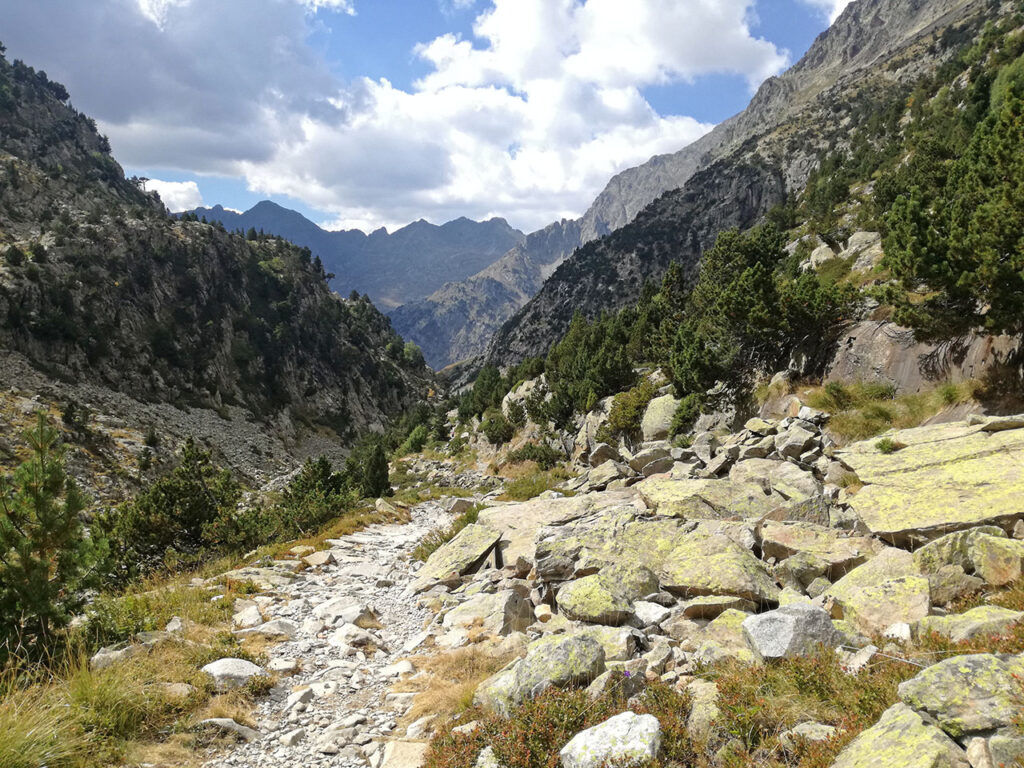
The GR10 and the GR11 are, in their own way, great hiking trails that traverse the Pyrenees. The HRP adds something different. As I venture into the high mountains, following a route means having to find my own path more and more often. The landscape becomes more rugged and conditions can change more quickly. A trail that seems obvious on the map may disappear on the ground among rocks, boulders, and slopes.
That perspective appeals to me precisely because I know that I won't be able to have everything under control.
I know that I will have to be well-prepared. I know that I must choose my material carefully and that I will not always find water and food readily available. I also know that no preparation will prevent the mountains from following their own rules. Time changes, an itinerary can turn out differently from what was planned, and my body will also have something to say about how many kilometers I can cover each day.
That is why the Pyrenean Triple Crown, my journey through the Pyrenees, does not seem to me like a project that simply has to be carried out. It is an adventure in which preparation, experience, the ability to overcome obstacles, and improvisation will be present at all times.

More than 2,500 kilometers through the mountains
When I add up the distances of the three routes, I get about 2,500 kilometers. That is a figure that forces me to breathe deeply. Not because the distance scares me, but because I know how many days and how many different situations can fit into it.
Still, I try not to obsess over that number. I’ve traveled enough long distances to know that a journey of thousands of miles cannot be undertaken while constantly thinking about those thousands of miles. It simply doesn’t work that way. You focus on the day ahead, the next climb, the next water point, and finally, the place where you’ll set up your bivouac that night.
In this way, something enormous becomes manageable.
A climb becomes the ascent we have to face today. A long descent, in a few hours of walking. And a distance of 2,500 kilometers ends up being a sum of small moments that, together, form a great adventure.
Perhaps that's why I keep returning to long distances. The scale is immense, but the reality remains small: feet on the ground, a backpack on my back, and once again, the next step.
I still don't know how this story ends
Perhaps the most beautiful thing about this adventure is that the story is yet to be written. I can study the routes, consult maps and make plans, but I still don’t know what will happen along the way. I also don’t know what the weather will be like, who I’ll meet, where I’ll end up staying longer than expected or when I’ll have to change my plans. And I want to preserve precisely that uncertainty.
I don't need to leave everything closed off to be prepared. In fact, the more time I spend on the go, the more I realize that leaving room for flexibility can be as important as preparing. Room to listen to my body, to make another decision, and to simply discover where the path leads me.
For me, that is the essence of adventure. Not having the certainty that everything will turn out well, but being willing to face whatever comes up.

Next summer I will cross the Pyrenees
Next summer I have a rendezvous with the Pyrenean Triple Crown. I will link up the GR10, the GR11 and the HRP to cross the Pyrenees. It will be a journey of many kilometers, a lot of elevation gain and long days in a landscape that constantly changes.
I know it will be hard. I also know that there will be times when I will wonder why I get involved in something like this. But I’ve learned that those moments usually end up being part of the stories I like to tell the most later on.
For now, the adventure is still ahead. The map is on the table, the lines are drawn, and the first preparations have already begun. I prefer to leave the rest a little more open. Because, as much as I may plan, the Pyrenees will be the ones who have the final say on what happens along the way. And that is exactly why I am so eager to get started.
I know where I want to start and in which direction to move forward. But the path that will open up before me through the Pyrenees I will discover next summer.

 Spanish
 English
 French